QUICK OVERVIEW
Key Takeaways
- 1. Select the hair dryer configuration—plug-in, wall-mounted or hose—before comparing wattage, features or price.
- 2. Evaluate real drying performance through airflow, heat control, ergonomics and sample testing rather than wattage alone.
- 3. Coordinate hair dryer location, cable or hose reach and mounting with the mirror, vanity and bathroom electrical plan.
- 4. Include housekeeping reset, engineering service and replacement access in the specification.
- 5. Approve the full guest-use sequence in a representative mock-up bathroom before bulk procurement.
Why Hotel Hair Dryer Selection Is More Than a Wattage Decision
A hotel hair dryer is a small guest-facing appliance, but it has a direct effect on bathroom usability, electrical coordination, perceived room quality and daily hotel operations. It is used frequently, handled by many different guests, exposed to humid environments and often installed close to mirrors, basins and joinery. For that reason, the correct specification cannot be reduced to wattage alone.
A product that appears powerful on paper may still be uncomfortable to hold, too noisy for the room concept, poorly positioned, difficult to service or unsuitable for the available electrical arrangement. Conversely, a lower-wattage model may work well in one property but feel underpowered in another depending on airflow design, heat control and guest expectations.
The first decision is therefore not ‘Which hair dryer has the highest wattage?’ but ‘What type of hair dryer best fits the room, bathroom layout and operating model?’ A city business hotel, resort, luxury property, serviced residence and compact urban hotel may require different priorities.
This guide explains how to compare plug-in, wall-mounted and hose hair/body dryer systems across power, airflow, heat settings, motor type, noise, cable design, mounting, electrical safety, bathroom zoning, guest ergonomics, housekeeping, engineering support and procurement control.
Define the Bathroom Hair Dryer Requirement Before Comparing Models
The project should define the intended installation concept before requesting quotations. Suppliers can only be compared properly when they are responding to the same requirement.
A loose plug-in dryer stored in a drawer is a different solution from a wall-mounted unit beside the mirror. A hose dryer permanently installed on the wall has a different user experience, airflow profile and maintenance requirement again.
A useful project brief should identify:
- room types and quantities;
- plug-in, wall-mounted or hose system preference;
- intended bathroom or dressing-area location;
- available electrical supply and socket position;
- required voltage and frequency for the destination market;
- target power range;
- heat and speed settings;
- cool-air function where required;
- motor and expected duty level;
- noise expectations;
- cable length and storage method;
- wall bracket or cradle requirement;
- automatic switch or holder-activated operation where applicable;
- shaver-socket or integrated electrical module requirement where applicable;
- guest reach and mirror relationship;
- housekeeping storage and reset procedure;
- service and replacement access;
- sample-room approval process.
The Three Main Hotel Hair Dryer Configurations
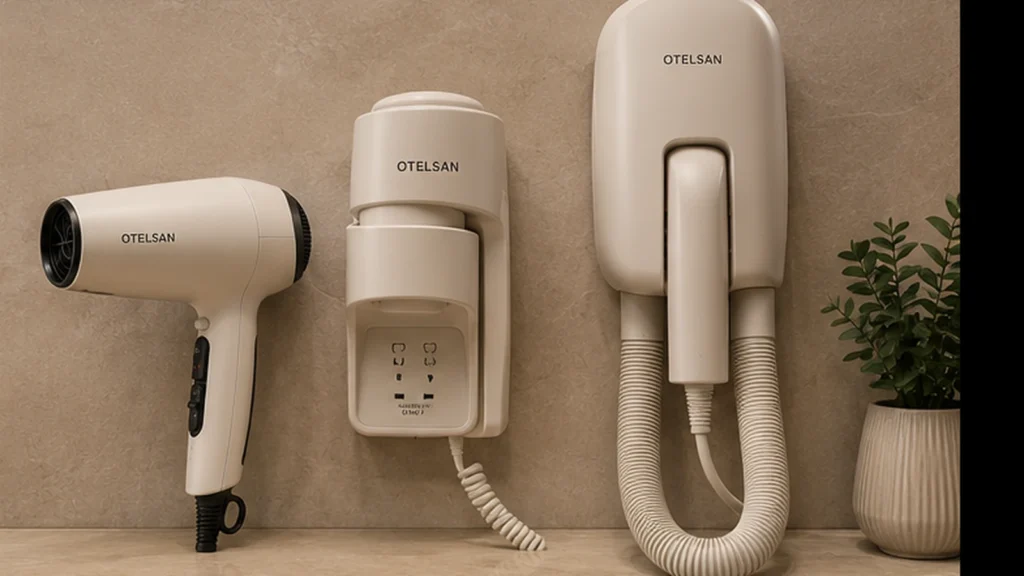
Hotel projects generally consider three broad configurations: plug-in hand-held hair dryers, wall-mounted hand-held dryers with a dedicated holder or base, and hose-type hair/body dryers. Each has a different balance of flexibility, permanent installation, guest handling and maintenance.
Plug-In Hand-Held Hair Dryers
A plug-in hand-held dryer is the most familiar format for guests. It can be stored in a drawer, wardrobe, vanity compartment or dedicated pouch and plugged into an approved socket when needed.
The main advantages are flexibility, straightforward replacement and broad model choice. The main project challenge is storage. If the dryer has no defined home, it can be left on the vanity, moved between rooms or wrapped inconsistently by housekeeping.
Cable length, plug type, storage size and the relationship between the socket and mirror should be checked in the sample room. The guest should not need to stretch the cable across a wet area or move furniture to reach the outlet.
Wall-Mounted Hand-Held Hair Dryers
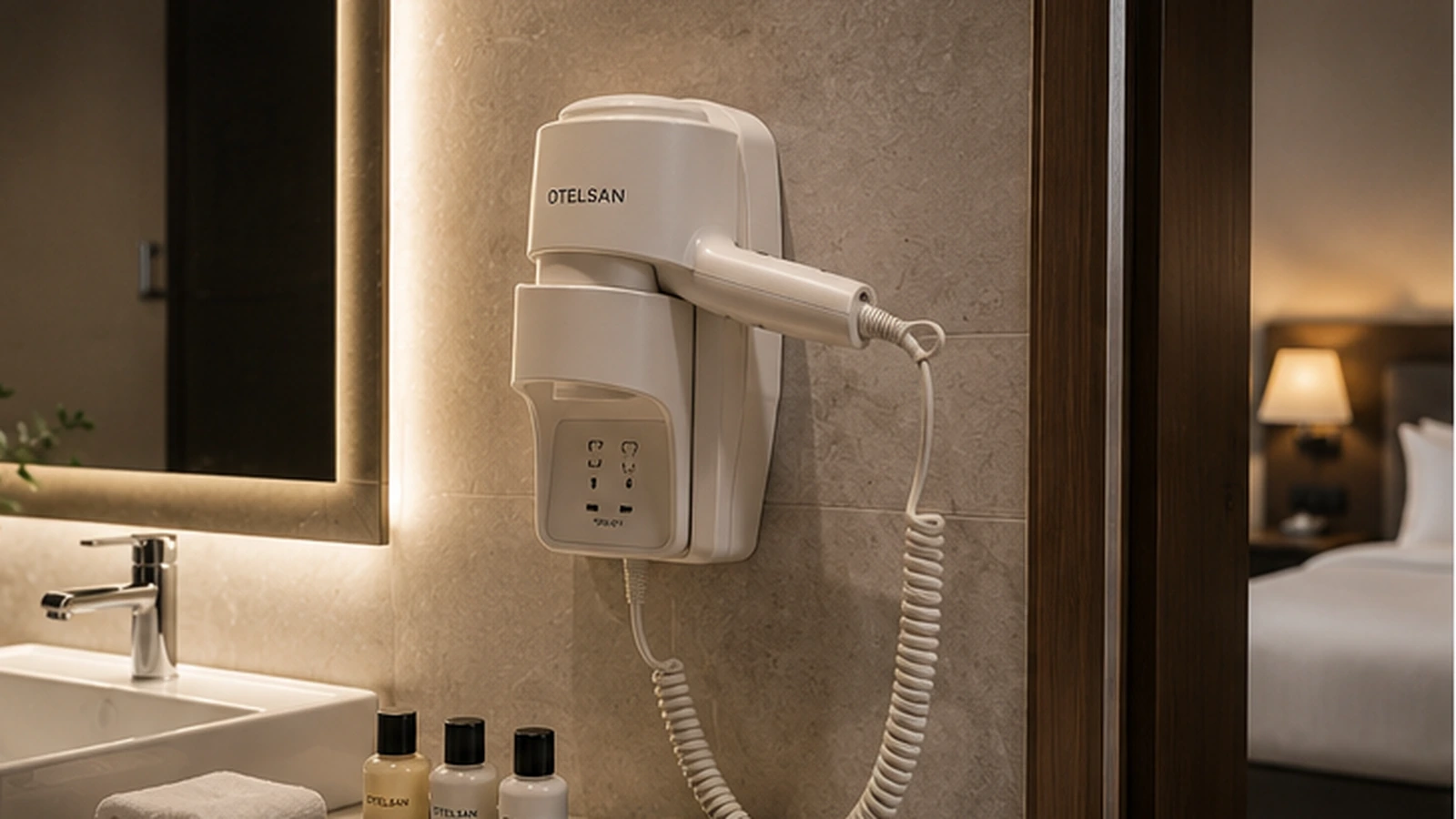
Wall-mounted systems combine a hand-held dryer with a fixed bracket, cradle or base. They create a clear storage position and reduce the chance that the dryer is misplaced.
Depending on the model, the bracket may be purely mechanical or may include electrical connection, shaver socket, switch or holder-activated control. These functions need to be coordinated with the bathroom electrical design.
The mounting height, bracket location and cable reach should be tested with the mirror and vanity layout. A neatly mounted unit can still be awkward if the guest must reach across the basin or if the cable does not comfortably reach the normal styling position.
Hose Hair / Body Dryers
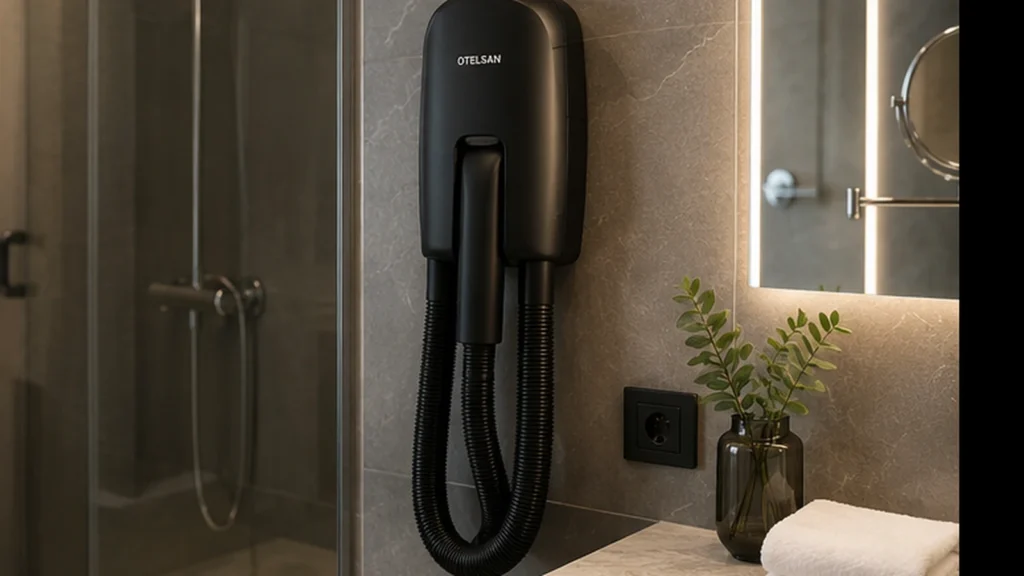
Hose-type systems use a fixed wall-mounted base with flexible hose and handpiece. They can be used for hair drying and, depending on design, body drying.
These systems create a permanent installation and keep the main motor assembly fixed to the wall. The user handles the hose and nozzle rather than the complete motor body.
The project should review hose length, hose flexibility, storage position, heat and airflow performance, mounting height and service access. Because the base is fixed, installation planning is especially important.
Hose systems can suit properties that prefer a permanent bathroom appliance with controlled storage, but they should be evaluated through a real sample because the guest experience is different from a conventional hand-held dryer.
Configuration Comparison for Hotel Projects
| Decision factor | Plug-in hand-held | Wall-mounted hand-held | Hose hair/body dryer |
|---|---|---|---|
| Installation | Loose appliance with approved socket. | Fixed holder/base plus hand-held appliance. | Fixed wall-mounted base with hose and nozzle. |
| Storage control | Requires drawer, pouch or defined storage location. | Clear return position on wall or furniture. | Integrated into fixed installation. |
| Replacement | Generally straightforward. | Dryer or bracket may need model-specific replacement. | Base/hose components may require more specific service. |
| Guest familiarity | Very familiar format. | Familiar hand-held use with fixed storage. | Different handling experience; sample review recommended. |
| Electrical coordination | Socket location is critical. | Bracket/base wiring or socket arrangement may be required. | Fixed electrical installation typically needs early coordination. |
| Best-fit discussion | Flexible projects prioritising familiar use and simple replacement. | Projects seeking organised storage and fixed presentation. | Projects preferring permanent bathroom installation and hose-based use. |
Wattage, Heat and Real Drying Performance
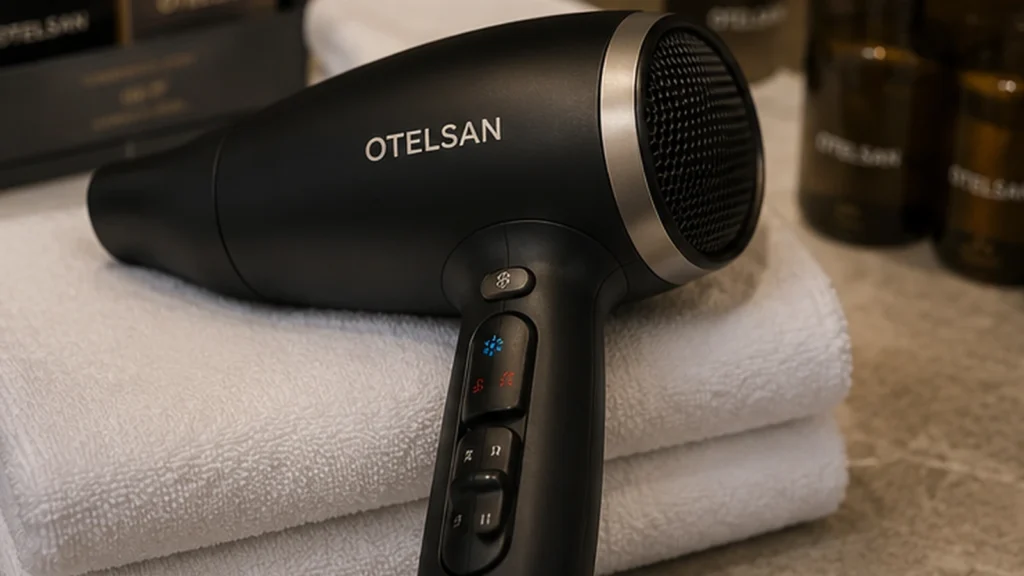
Wattage is one of the first figures shown on a hair dryer specification, but it is not a complete measure of drying performance. Electrical input power influences available heating and motor output, yet airflow design, motor efficiency, nozzle geometry, temperature control and internal construction all affect the result.
Two dryers with similar wattage can feel different in use. One may produce stronger concentrated airflow, another may deliver more heat but less air movement. The guest experiences the complete airflow and temperature profile, not the wattage number.
For project comparison, record rated wattage but also request information on speed settings, heat settings, airflow performance where declared and the intended duty level. A sample test is particularly useful because it reveals grip comfort, noise, airflow concentration and perceived drying speed.
Higher wattage also affects room electrical loading. The product specification should therefore be coordinated with the destination voltage, bathroom circuit and other appliances connected to the room.
Heat Settings, Speed Settings and Cool-Air Function
Multiple heat and speed settings allow guests to adjust drying intensity. The required number of settings should reflect the hotel segment and product design rather than an assumption that more switches are always better.
A clear two- or three-stage control can be more intuitive than a complicated interface. Switches should be easy to operate with one hand and remain legible after repeated cleaning.
A cool-air function can be useful for styling or reducing heat exposure. If it is included, check whether it is a separate button, a fixed setting or a momentary control.
The project should also evaluate whether the controls can be changed accidentally while holding the dryer. Poorly positioned switches can make normal use frustrating.
Motor Type and Expected Duty
Hair dryers may use different motor designs, and the appropriate choice depends on the expected operating intensity, product quality level and maintenance strategy.
For hotel projects, the key questions are not only the motor label but expected service life, noise, airflow stability and the supplier’s support for the exact model.
A guest room dryer does not operate continuously like some salon equipment, but it is used by many different guests and can be handled roughly. The product needs to tolerate repeated short-duration use, frequent plug/unplug cycles where applicable and regular housekeeping contact.
If the supplier declares a motor-life figure, confirm the test basis before using it as a direct comparison. Different test methods can make headline figures difficult to compare.
Noise and Guest Comfort
Hair dryers are inherently audible, but the character and intensity of the sound varies considerably. Noise matters because the appliance is used inside the guest room environment, sometimes early in the morning or late at night.
A high-pitched motor can feel more intrusive than a lower-frequency sound even when measured sound levels are similar. For this reason, sample testing is useful.
The bathroom itself also affects perceived noise. Hard surfaces, mirrors and tiled walls reflect sound, while the open or closed bathroom door changes how much noise reaches the sleeping area.
If the property places particular emphasis on acoustic comfort, compare real samples inside a representative bathroom rather than relying only on catalogue descriptions such as ‘quiet’ or ‘low noise’.
Handle Ergonomics, Weight and Balance
A hair dryer may be held for several minutes, so weight and balance matter. A powerful product that feels front-heavy or requires excessive grip force can reduce guest comfort.
The handle should provide enough clearance for different hand sizes and should not become uncomfortable as the appliance warms.
Check whether switches sit naturally under the fingers without being triggered accidentally. The cable exit should not interfere with grip.
For wall-mounted or hose systems, evaluate the handpiece separately from the base. Hose tension should not pull the nozzle away from the guest during normal use.
A sample-room test with several users can reveal ergonomic issues that technical data will not show.
Cable Length, Spiral Cords and Cable Storage
Cable design is a major project detail. A cable that is too short restricts the guest’s position; a cable that is too long creates clutter and can contact wet surfaces or become tangled.
Straight cables are common for plug-in dryers. Spiral cords can reduce visible loose cable on some wall-mounted systems but can create pulling force if stretched too far.
The correct cable length depends on socket position, mirror width, vanity depth and expected guest standing position.
Do not assume a standard cable length works in every room. Test the actual model in the mock-up bathroom and confirm that the guest can move naturally without pulling against the socket or wall bracket.
Electrical Safety and Bathroom Coordination
Electrical appliances used in bathrooms require careful coordination with the project’s electrical design and applicable local regulations. The exact requirements vary by country and project, so the hair dryer specification must be reviewed together with the electrical consultant and destination-market standards.
The location of sockets, fixed wiring and wall-mounted appliances should respect the bathroom’s defined electrical zones and protection requirements. The product should be installed only where permitted for the selected equipment and local code.
Where residual-current protection, isolation, fused connection or other measures are required, these should be incorporated into the project design.
Do not assume that because a hair dryer is marketed for hotels it can be installed in any position within any bathroom.
Voltage, Frequency and Destination Plug Type
International hotel projects must confirm voltage and frequency before order placement. A dryer designed for one electrical system may not be suitable for another.
Plug type should match the destination market and the approved guest room socket strategy. Adaptors should not be treated as a normal project solution unless specifically approved.
If the hotel expects international guests, this does not mean the hair dryer itself needs universal voltage. It means the installed appliance must be correct for the building’s electrical supply.
The rated electrical data should appear clearly in the procurement schedule and final technical documentation.
Wall Brackets, Cradles and Holder Design
For wall-mounted dryers, the holder is part of the product system. It determines storage, cable position, guest access and the visual quality of the installation.
A bracket should retain the dryer securely without requiring excessive force to remove or replace it. The guest should understand intuitively how the dryer sits in the holder.
Some holders activate or isolate power when the dryer is removed or returned. If this function is required, verify how it works and how it is serviced.
The wall substrate must support the fixing method. Tile, stone, mirror panels, laminate and hollow partitions each require different installation consideration.
Mounting drawings should be reviewed before the bathroom wall finish is complete, particularly when concealed wiring is involved.
Installation Height and Mirror Relationship
The hair dryer should be installed where the guest can reach it naturally while using the mirror. A product mounted too high or too low can be inconvenient even if it looks visually aligned with other accessories.
Consider the height of the vanity, mirror, wall lights and nearby accessories. The dryer should not interfere with towels, magnifying mirrors, shelves or dispensers.
Cable or hose reach should allow the guest to stand in a comfortable styling position without leaning over the basin.
For accessible rooms, reach range and mounting position should be reviewed against the project’s accessibility requirements.
Air Intake, Filters and Maintenance Access
Hair dryers need clear airflow into the motor. Blocking the air intake can reduce performance and increase operating temperature.
Check where the intake is located and whether normal hand placement can obstruct it. For wall-mounted systems, make sure the holder does not restrict ventilation.
Some products use removable or cleanable filters. If so, confirm how housekeeping or engineering accesses them and how often the supplier recommends inspection.
The filter or intake should not become a dust trap that is difficult to reach. Maintenance access is especially important in hose systems where the main unit is fixed to the wall.
Overheat Protection and Automatic Safety Functions
Professional hotel dryers should include appropriate thermal protection for the product design. The exact arrangement varies, but the purpose is to prevent continued unsafe operation if airflow is blocked or internal temperature rises abnormally.
Some wall-mounted systems also use holder-based switches or timers to limit unintended operation.
The project team should understand which safety functions are included and how the product behaves after a protection event. Does it reset automatically after cooling, require manual reset or need service inspection?
Supplier documentation should control the final understanding rather than generic assumptions about hair dryers as a product category.
Bathroom Environment, Moisture and Surface Durability
The bathroom environment includes humidity, steam, cleaning chemicals and repeated wiping. External plastics, painted parts, chrome surfaces and labels need to maintain appearance under these conditions.
Glossy finishes can show fingerprints and scratches more readily. Matte finishes can hide some marks but may respond differently to cleaning products.
Wall brackets and screws should be reviewed for corrosion resistance appropriate to the intended environment.
If the dryer is stored outside the bathroom in a wardrobe or drawer, humidity exposure may be lower, but housekeeping storage and cable handling become more important.
Storage for Plug-In Hair Dryers
Loose dryers need a defined storage location. Common options include drawers, shelves, dedicated pouches or fitted compartments.
The storage location should be easy for the guest to find. A dryer hidden in an unexpected drawer can generate reception calls even when the product itself is excellent.
The cable should fit without being sharply bent or tightly wrapped around the appliance. Repeated over-tight wrapping can place stress on cable entry points.
If a pouch is used, it should be appropriately sized and easy to clean. The dryer should be cool before storage according to the supplier’s guidance.
Housekeeping needs a consistent reset standard so the dryer appears in the same place and condition in every room.
Housekeeping Inspection and Daily Reset
Housekeeping may not service the internal electronics, but it interacts with the hair dryer every day. Staff can identify damaged cables, cracked housings, loose wall brackets, missing accessories or abnormal appearance before the next guest uses the appliance.
The room checklist should define what housekeeping should inspect and when the issue should be escalated to engineering.
For plug-in dryers, staff should return the dryer to the approved storage position and arrange the cable consistently.
For wall-mounted units, the dryer should sit securely in the cradle and the cable should not hang across the vanity.
For hose units, the hose and handpiece should be returned neatly without kinks that can damage the hose or restrict airflow.
Engineering, Serviceability and Replacement
A hotel needs a practical method to replace a failed dryer without taking the room out of service for an extended period.
Plug-in dryers are generally easiest to exchange, provided the replacement model fits the existing storage and electrical strategy.
Wall-mounted products may require compatible brackets, wiring or mounting-hole positions. Replacing one model with another can therefore create visible wall damage or require new fixings.
Hose systems may have model-specific base dimensions and service components. The project should consider spare units or spare parts for larger installations.
Record the exact model, finish, electrical rating and mounting configuration in the handover documentation.
Standardisation Across Room Types
Using one hair dryer model across most room types simplifies procurement, housekeeping training, engineering support and spare stock.
Variation should be introduced only when there is a clear operational or design reason. Suites may receive a higher-specification hand-held dryer, while standard rooms use a simpler model. Accessible rooms may require a different installation position rather than a different product.
If multiple models are used, document them in the room-type matrix together with mounting location and electrical requirements.
Avoid cosmetic variation that creates operational complexity without meaningful guest benefit.
How to Compare Hotel Hair Dryer Quotations
A technical comparison should go beyond wattage and unit price. Require each supplier to identify the exact model and configuration.
At minimum, compare:
- plug-in, wall-mounted or hose configuration;
- exact model reference;
- rated voltage and frequency;
- rated power;
- destination plug or wiring arrangement;
- heat settings;
- speed settings;
- cool-air function where applicable;
- motor type where declared;
- airflow performance where declared;
- noise information where available;
- dryer weight;
- handle and switch layout;
- cable type and length;
- wall bracket or cradle design;
- holder-activated switch or timer where applicable;
- hose length for hose systems;
- overheat protection;
- air intake and filter arrangement;
- surface material and finish;
- mounting method;
- required installation dimensions;
- service and spare-parts support;
- warranty terms;
- sample availability;
- delivery lead time;
- packaging and project labelling.
Project teams can review the OTELSAN product catalogue when comparing hair dryers and wider bathroom equipment against the project requirement.
Mock-Up Room and Sample Approval
A sample should be tested in the actual bathroom or a representative mock-up. Install or place the dryer exactly where the guest will use it.
Check reach, cable or hose length, mirror visibility, switch operation, grip comfort, airflow, heat, noise and storage.
For wall-mounted systems, confirm that the bracket feels secure and that the dryer can be removed and returned easily. For plug-in models, test the approved drawer or pouch. For hose units, confirm that the hose reaches the expected standing position without excessive pulling.
The electrical installation and bathroom-zone suitability should be confirmed before final approval.
Photograph the approved location and record mounting height, model, finish and any room-type exceptions.
Common Hotel Hair Dryer Specification Mistakes
Choosing only by wattage. Drying performance also depends on airflow design, heat control, motor and nozzle geometry.
Leaving installation type undecided. Plug-in, wall-mounted and hose systems require different room coordination.
Ignoring bathroom electrical zones. Product location must comply with project and local safety requirements.
Placing the socket too far from the mirror. The guest should not need to stretch the cable across the vanity.
Installing the bracket for visual symmetry rather than reach. The guest-use position should control the final location.
Not testing cable or hose length. Catalogue length does not guarantee comfortable use in the actual room.
Ignoring storage for plug-in dryers. Loose appliances need a defined housekeeping reset position.
Assuming all ‘quiet’ dryers sound alike. Real acoustic character should be tested in the bathroom.
Forgetting service access. Fixed systems should be replaceable without damaging finished walls.
Using several models without a room matrix. This complicates spares, training and future replacement.
Practical Pre-Order Hotel Hair Dryer Checklist
Before releasing a hotel hair dryer order, confirm the following for every applicable room type:
- Exact hair dryer model.
- Room types and quantity allocation.
- Plug-in, wall-mounted or hose configuration.
- Installation location.
- Rated voltage.
- Frequency.
- Rated power.
- Destination plug type or fixed wiring method.
- Heat settings.
- Speed settings.
- Cool-air function where required.
- Motor type where relevant.
- Declared airflow information where available.
- Declared noise information where available.
- Dryer weight.
- Handle ergonomics.
- Switch position and usability.
- Cable type.
- Cable length.
- Hose length for hose systems.
- Wall bracket or cradle type.
- Holder-activated control where applicable.
- Air intake location.
- Filter access.
- Overheat protection.
- Surface material and finish.
- Bathroom electrical-zone compliance.
- Required circuit protection.
- Socket or connection-point location.
- Mounting height.
- Mirror relationship.
- Vanity and basin clearance.
- Accessible-room requirements where applicable.
- Housekeeping storage/reset procedure.
- Engineering service procedure.
- Replacement access.
- Spare-unit strategy.
- Warranty.
- Service and spare-parts support.
- Sample-room approval status.
- Approved installation drawing.
- Final quantities and delivery sequence.
The final specification should be coordinated with the property’s electrical consultant, bathroom design, destination-market requirements and hotel operating procedures. Product-specific installation instructions remain essential for the approved model.
Frequently Asked Questions
What type of hair dryer is best for a hotel room?
There is no single best format for every property. Plug-in hand-held dryers offer flexibility and easy replacement, wall-mounted hand-held systems provide organised storage, and hose dryers create a permanent bathroom installation. The room layout, service concept and electrical design should determine the choice.
How many watts should a hotel hair dryer have?
Wattage should be considered together with airflow, heat settings, motor design and the room’s electrical capacity. Higher wattage does not automatically mean better guest performance. Compare real samples and supplier data for the exact models.
Are wall-mounted hotel hair dryers better than plug-in models?
They offer different advantages. Wall-mounted models create a clear storage position and can reduce misplacement, while plug-in models are generally easier to replace and can be stored out of sight. The best solution depends on the property.
What is a hose hair dryer?
A hose hair dryer uses a fixed wall-mounted base with a flexible hose and handpiece. Depending on design, it may support hair drying and body drying. Hose length, airflow, mounting height and service access should be reviewed in the sample room.
Can a hotel hair dryer be installed next to a basin?
Only when the installation complies with the project’s electrical design and applicable local bathroom-zone requirements. The correct location depends on the product, electrical protection and destination regulations.
Why does cable length matter?
The guest needs enough reach to stand comfortably at the mirror without pulling the plug or stretching the cable across wet or obstructed areas. The correct length depends on the actual socket and mirror positions.
Should a hotel hair dryer have a cool-air function?
It can be useful for styling and guest comfort, but it is not mandatory for every property. The feature should be selected according to the intended product level and guest expectation.
How should plug-in hair dryers be stored?
Use a defined drawer, shelf, pouch or fitted compartment. The storage position should be easy for guests to find and easy for housekeeping to reset consistently.
What should be tested in the mock-up bathroom?
Test reach, cable or hose length, mirror position, grip, controls, airflow, heat, noise, bracket security, storage, electrical connection and replacement access.
Can one hair dryer model be used across the entire hotel?
Often yes, and standardisation can simplify purchasing, housekeeping and engineering. Different models should be introduced only when room type, service level or installation constraints justify the variation.
Conclusion: Specify the Hair Dryer as Part of the Bathroom System
A hotel hair dryer should be selected as part of the bathroom and guest-room equipment package, not as an isolated electrical appliance. Installation type, power, airflow, cable or hose reach, mirror position, electrical safety, storage and serviceability all influence the final result.
Start by defining the preferred configuration, coordinate the exact installation with the bathroom electrical plan and test the product in a representative mock-up. A technically suitable dryer can still fail the project if it is badly positioned or difficult to use.
Project teams can review the Guestroom product groups and the complete Guestroom product range when coordinating hair dryers with mirrors, bins and wider bathroom equipment. Once room types and quantities are defined, teams can build a project quote list for project-based evaluation.
For hotel openings, renovations or multi-room bathroom-equipment specifications requiring coordinated support, contact the OTELSAN project team with room types, quantities, destination, bathroom layout and required hair dryer configuration.